
How to Remove “Powered by WordPress” From the Footer (Any Theme)

To remove “Powered by WordPress” from your footer, edit the footer where your theme builds it. In a block theme such as Twenty Twenty-Five, open Appearance > Editor, edit the Footer template part and delete or replace the credit. In a classic theme, look for a copyright or footer setting under Appearance > Customize. If your theme has no setting, hide the credit with a short CSS rule.
I tested the first three methods on WordPress 7.1.3 with three themes: Twenty Twenty-Five (block theme), Astra (classic theme with a footer setting) and Twenty Twenty-One (classic theme without one).
| Your theme | Example | Best method |
|---|---|---|
| Block theme (Appearance > Editor exists) | Twenty Twenty-Five, Twenty Twenty-Four | Method 1: edit the footer in the Site Editor |
| Classic theme with a footer or copyright setting | Astra, Kadence and similar themes | Method 2: change the text in the Customizer |
| Classic theme without a setting | Twenty Twenty-One | Method 3: hide it with CSS, or Method 4: a child theme |
Are You Allowed to Remove the Credit?
Yes for WordPress itself. WordPress is released under the GNU General Public License (GPL), which lets you change it however you like, including removing the credit. Free themes from WordPress.org are GPL too. Some commercial themes ask you to keep their credit unless you buy a license, so check your theme’s terms if it’s a premium theme. My guide on activating a WordPress theme license shows where those terms and keys usually live.
Block themes build the footer from blocks, so you edit the credit like any other paragraph. Twenty Twenty-Five shows “Designed with WordPress” at the bottom right:

Go to Appearance > Editor > Patterns, click Footer in the template parts list and open the footer your theme uses. You can also open any template and click the footer.
Step 2: Change or Delete the Credit
Click the credit paragraph. Type your own text, such as a copyright line, or press the paragraph’s options (⋮) and choose Delete. Then click Save.

The change applies to every page that uses the footer:

Your edit is saved in the database, so theme updates won’t bring the credit back. To undo it, go back to Appearance > Editor > Patterns > Footer, open the actions menu (⋮) next to your footer and choose Reset. This restores the theme’s original footer and removes all your footer edits, not just the credit change.
Many classic themes let you edit the footer text in the Customizer. Astra, for example, shows “Powered by Astra WordPress Theme” by default:

Step 1: Open the Copyright Setting
Go to Appearance > Customize > Footer and click Copyright. Other themes use names such as Footer, Footer Builder, Bottom Bar or Site Info.
Step 2: Edit the Text and Publish
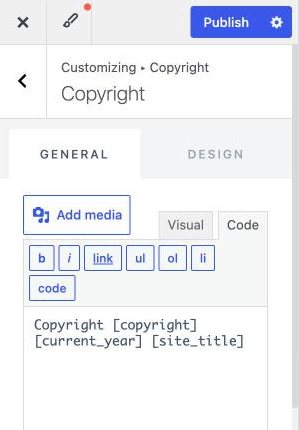
Delete | Powered by [theme_author] and keep or write your own text. If you delete only the words “Powered by”, the [theme_author] placeholder still prints “Astra WordPress Theme”. Astra uses placeholders such as [current_year] and [site_title] that update automatically. I switched to the Code tab to edit the text precisely. Click Publish when you’re done.

If your theme has no footer setting in the Customizer, check its own options page under Appearance, then use Method 3.
If your footer was made with a page builder such as Elementor, changing a theme setting may have no visible effect. Open the builder’s theme builder or saved templates, find the active footer template and edit the widget or block that holds the credit. In Elementor Pro, that is Templates > Theme Builder, then Footer. Save the template and check which pages its display conditions cover. Some builders need a paid feature for global footer templates, so check the tools your site already uses.
Method 3: Hide the Credit With CSS
Older and simpler classic themes print the credit directly from a theme file. Twenty Twenty-One is a good example: it shows “Proudly powered by WordPress” with no option to change it.

On a classic theme, go to Appearance > Customize > Additional CSS and add a rule that targets only the credit. For Twenty Twenty-One it’s:
.site-info .powered-by {
	display: none;
}
Click Publish, then reload your site to check the footer.
The Customizer and its Additional CSS panel only exist on classic themes. On a block theme, go to Appearance > Editor > Styles, open the ⋮ menu, choose Additional CSS, add your rule and click Save. On a block theme, though, Method 1 removes the credit properly, so you rarely need CSS.


To find the right class in another theme, right-click the credit, choose Inspect and look for the element that wraps it, often with a class like site-info, powered-by or footer-credits. Target that element only. A broad rule such as #site-footer a { visibility: hidden; } hides every footer link, including your menus and privacy policy.
CSS only hides the text. The credit is still in the page’s HTML, which is harmless for visitors and search engines but means it isn’t truly removed.
Method 4: Remove It in a Child Theme
If you want the credit gone from the HTML in a classic theme without a setting, copy the theme’s footer.php into a child theme and delete the credit there. In Twenty Twenty-One, that’s the whole <div class="powered-by"> block near the end of the file. Never edit the parent theme’s file directly, because the next theme update overwrites it. If you haven’t made a child theme before, follow the WordPress child theme guide. Your copied footer.php won’t receive future fixes the parent theme makes to that file, so use CSS unless you need the credit gone from the HTML.
If you don’t want to touch CSS or theme files, install the free Remove Footer Credit plugin and go to Tools > Remove Footer Credit. Enter the exact credit text or HTML in the first box, add replacement text in the second box if you want, and save. The plugin swaps the text before the page is shown, so it works with most classic themes. For block themes, Method 1 is simpler and doesn’t need a plugin.
When I checked on October 17, 2026, the plugin’s WordPress.org page listed it as tested up to WordPress 7.1, with a recent update. Check that page before you install it on an older or much newer version.
Once the credit is gone, the footer is a good place for a copyright line and useful links, such as your privacy policy and contact or terms pages. Keep the year current with your theme’s year placeholder, such as Astra’s [current_year]. In a block theme, update the year each January or leave it out. For other footer changes, such as menus, widgets or layout, see how to edit the footer in WordPress, and to add a logo or badge, follow my guide to adding an image to the WordPress footer.
- Clear your caching plugin, host cache and CDN cache, then check the page in a private browser window.
- Make sure you edited the footer the page actually uses. Some themes and builders have several footer templates.
- Check whether a plugin or page builder overrides the theme’s footer.
- If only mobile or one page still shows the credit, review the template’s display conditions and responsive visibility settings.
Afterwards, test your footer links and any forms in the footer. If a theme or builder conflict stops the right footer from showing, my WordPress repair service can help. Send the affected URL and the footer template you edited.
Frequently Asked Questions
Does removing “Powered by WordPress” improve security?
Not in any meaningful way. WordPress sites are easy to identify from file paths such as /wp-content/, so hiding the credit doesn’t stop anyone from knowing you use WordPress. Keep WordPress, themes and plugins updated instead, and follow the WordPress hardening guide.
Not in any way you’d notice. It’s one short sitewide link to WordPress.org or your theme’s author, so removing it is a branding choice, not an SEO fix.
Why did the credit come back after a theme update?
You probably edited the parent theme’s files, which updates replace, or the update changed the credit’s HTML so your CSS rule or plugin text no longer matches. Use the Site Editor, the theme’s settings, Additional CSS or a child theme, because those survive updates.
How do I remove “Proudly powered by WordPress” in Twenty Twenty-One?
Add .site-info .powered-by { display: none; } in Appearance > Customize > Additional CSS, as in Method 3, or remove the powered-by block from footer.php in a child theme.
- Change your WordPress menu colors
- Change the “Just another WordPress site” tagline
- If the text under your posts says “Leave a Reply”, that’s the comment form, not the footer. See how to remove or change the Leave a Reply form.


Thanks for sharing this, bookmarked.